Don't forget the quick navigation bar at the bottom of the page
Along the Monastic
Way Buckfast Abbey to Buckland Abbey
Hawson's Cross to Nun's Cross








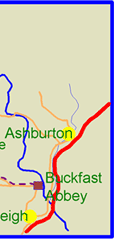
Click on number to go to picture and details of cross
|
|
DARTMOOR STONE CROSSES
by Bill Harrison Click on image to visit web site |
|
|
1
HAWSONS CROSS In 1952 the cross was restored by the Hartmoor Preservation Association in association with Mr. Masson-Phillips, who designed the shaft. The cross now stands 87" high. Starkey believes it is highly likely that the cross now stands very near to its original position where it acted as a marker along the Monks Path. FURTHER REFERENCES: |
|
|
2
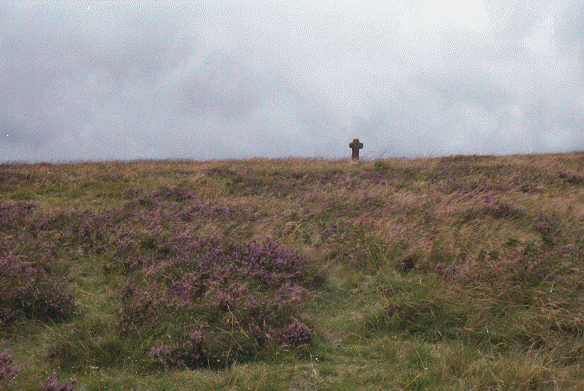
HORNS CROSS Horns cross marks the Monks Path across the moor and at its site another ancient track crosses the path. This is a track that connects places in the vicinity of Hexworthy and Dartmeet with South Brent. The cross is situated in a very prominent position and when visibility is good can be seen shortly after passing the two thorn trees situated on the path from Venford reservoir. Horns cross is also just visible from Horse Ford cross. Crossing relates that the ancient
name of the place where Horns cross stands was Stancombe's Telling-place,
from the practice of the farmer nearby of Staddiscombe, who regularly
gathered his sheep there to count them. |
|
|
3
HORSE
FORD CROSS Crossing was unable to find this cross for many years. A labourer he had consulted with insisted that he had seen it in the locality some years previously. In the summer of 1884 the labourer made a search for it and re-discovered it. At this time it consisted of the head and arms and small portion of shaft, measuring 24" from the fracture to the top of the shaft. The arms measured 27" across projecting 7" beyond the shaft. Partially buried in the earth close by was a portion of the broken shaft. The cross was restored and fixed in its current position. The cross is just visible as the hill from Horns Cross is descended towards Horse Ford on the O Brook. Starkey refers to this cross as "cross near Skir Ford". FURTHER REFERENCES: |
|
|
4
SKIR
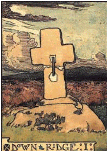
FORD CROSS Just a few hundred yards west of Horse ford cross is Skir Ford cross. In 1883 Crossing asked a farmer, by the name of Samuel Smith who lived at Hexworthy, to set the broken upper portion of the cross on a mound. It had been lying on the ground for many years prior to this and the lower portion measuring 35" had lay partially buried in the soil. In 1885 the shaft was joined with metal clamps and re-erected. The cross stands approx 58" high (72" as noted by Crossing) and just over 12" wide and 8" thick. The arms are 29" wide and 10" deep. The head rises 7" above the arms. This cross is visible after walking approx 170 paces from Horse Ford Cross due west. Starkey refers to this cross as "cross on
Down Ridge". |
|
|
5
TIRHILL
CROSS EAST Crossing describes this as a very fine cross in a complete state with the exception of a small piece broken off the shaft. Its height is 80" (as measured when it lay on the turf) erected it now stands just under 72" high. Across the arms it measures 26" the depth of the arms being 9" and from the top of the arms to the top of the cross is 13". The width of the shaft is about 10" and the thickness 8". Interseting this cross is set with its arms pointing along the path rather then along it. Starkey believes this was due to carelessness when the cross was re-erected in 1885. Crossing relates the story that a Mr. Coaker, of
Sherburton, several years ago (when written in 1900) removed the cross and
set it up in the courtyard of his farm. When the Duchy authorities became
aware of this he was obliged to restore it to its original site. It lay
there until it was re-erected. Crossing believes the damage to the shaft
probably happened when the cross was moved. The cross is just visible from
Skir Ford. |
|
|
6
TIRHILL
CROSS WEST Les Sutton emailed me to say "the cross that you refer to (Tir Hill cross West) is now no longer in this position. It has been replaced by a new cross dedicated to the memory of Tom Gant. The old battered cross is now in the Jack Wigmore memorial garden to the rear of the High Moorland Centre, Princetown." When Crossing first located this cross it was laying on the ground, its shaft broken. In 1885 the Dartmoor Preservation Society decided to re-erect this cross and others in the vicinity. The cross was repaired under the direction of Mr. E. Fearnley Tanner and Crossing says "the work was not totally satisfactory". The cross was set upright in a hole in the ground and shortly after had again been knocked down. Cattle using it asa rubbing post had also knocked off a previously cracked arm. Crossing states that if a socket stone could be found for the cross "two feet or more in height it might stand erect without danger of being overthrown". Since Crossing wrote the cross has been erected again and seems firmly set in a socket stone. Crossing measures the cross as 66" high but notes that part of the shaft was missing. The width across the arms is 26" wide, the same dimensions as Tir Hill Cross East and the two crosses which at one time lay side by side were possibly the same size. The cross is clearly visible from Tir Hill Cross
East |
|
|
7
MOUNT
MISERY CROSS In the summer of 1878 Crossing measured this cross as it was lying on the ground in an opening in the wall of the Fox Tor Newtake. It is 72" high, 28" across the arms and from the upper surface of the arms measures 9" to the top of the shaft. One of the top corners of the cross is not square but does not seem to have fractured. A few yards from where the cross lay was a socket stone and in 1879 the cross had been re-erected in the stone. However, in 1881 the cross was again lying on the ground and so it remained until 1885 when the cross was re-erected along with others in the area. This time it was cemented into the socket stone.When Crossing was in the area in 1881 he discovered the remains of another cross. It consisted of the top part of the shaft with one complete arm and a portion of the other and had obviously been buried for some time. Crossing believes this may have been the cross that originally stood on Childes Tomb. Starkey notes that this cross was photographed by Masson-Phillips propped against Mount Misery Cross. Mount Misery Cross is visible after walking a
short distance due west of Tir Hill Cross West and Childes Tomb is just
visible from Mount Misery Cross. |
|
|
8
CHILDE'S TOMB Risden says that "It is left us by tradition that one Childe of Plimstoke, a man of fair possessions, having no issue, ordained, by his will, that wheresoever he should happen to be buried, to that church his lands should belong. It so fortuned, that he riding to hunt in the forest of Dartmore, being in pursuit of his game, casually lost his company, and his way likewise. The season then being so cold, and he so benumed therewith, as he was enforced to kill his horse, and embowelled him, to creep into his belly to get heat; which not able to preserve him, was there frozen to death; and so found, was carried by Tavistoke men to be buried in the church of that abbey; which was so secretly done but the inhabitants of Plymstoke had knowledge thereof; which to prevent, they resorted to defend the carriage of the corpse over the bridge, where, they conceived, necessity compelled them to pass. But they were deceived by guile; for the Tavistoke men forthwith built a slight bridge, and passed over at another place without resistance, buried the body, and enjoyed the lands; in memory whereof the bridge beareth the name of Guilebridge to this day. (Survey of Devon, pp 198,199. Edit 1811). In the notes to Carrington's Dartmoor (published in 1826) Child's Tomb is said to have consisted of a pedestal formed by three steps. The lower one to have been formed by 4 stones 6 feet long by 12" square. The upper steps made of 8 smaller stones and on this was an octagonal stone with a cross fixed upon it. The writer states that "a socket and groove for the cross itself, with its shaft broken, are the only remains of the tomb. Crossing states that the tomb remained perfect until around the year 1812 when it was nearly destroyed by workmen of a Mr. Windeatt, who were building a farmhouse nearby. Crossing found the sight of the tomb around 1880 and, in addition to discovering a kistaven, also found a stone near the sight. He believed the stone had once formed the tomb as described by Carrington. Crossing found a further 8 stones forming a bridge spanning a small stream that falls into the Swincombe. Thus finding 9 of the 12 stones. Crossing expressed the hope that the monument would be re-erected but there is no indication in his book that it was restored during his life time. FURTHER REFERENCES: |
|
9
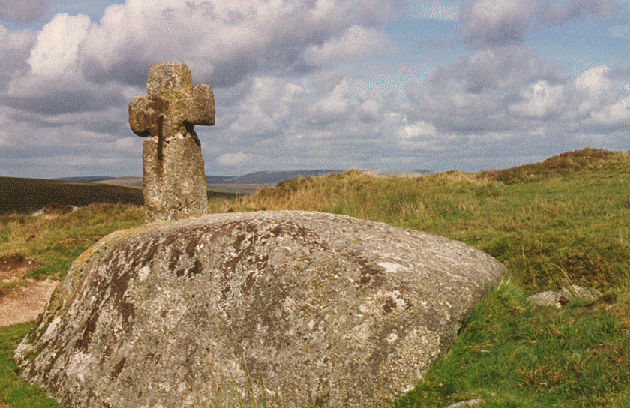
GOLDSMITHS CROSS Walking west from Childes Tomb along the southern edge of Fox Tor Mire for about half a mile Goldsmiths Cross is reached. This cross is firmly set in a socket cut in a large boulder. The cross was discovered in 1903 by Lt. Goldsmith, RN having been missing for many years. It was found not far from its original position. The cross has a short shaft, summounted by a small head, the arms expand slightly outward. The head has broken from the shaft at some time and is now secured with an iron clamp. FURTHER REFERENCES: |
|
|
|
10
NUNS OR SIWARDS CROSS The largest of the old crosses on Dartmoor - 88" high and 32" across the arms. It tapers across the width from the head 22" to 17" at its base and is, on average 14" thick. The shaft has been repaired with an iron clamp on each side of the shaft to hold it together. Crossing relates that the cross was overturned by two lads who were out looking for cattle and seeing that the cross rocked in its socket tipped it over. This incident is thought to have occured in 1846. By 1848 it was erect again. The cross forms a boundary mark of the forest and was mentioned in the perambulation of 1240. On the eastern face across the arms the word Syward or Siward is inscribed (photograph 11/68 and 11/69) and on the western face there is a small incised cross and the word Boclond (photograph 11/70). Crossing believes the cross to have been set up
by the monks of Tavistock Abbey. Brewer, Dave (1986) Boundary Markers on and Around Dartmoor. Devon, Devon Books |

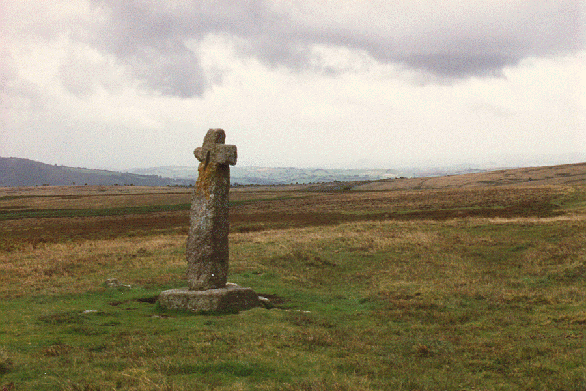
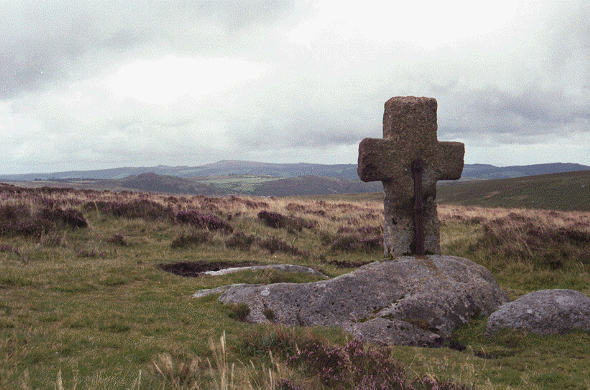
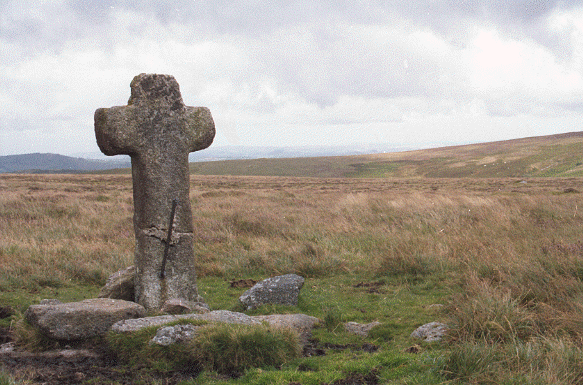
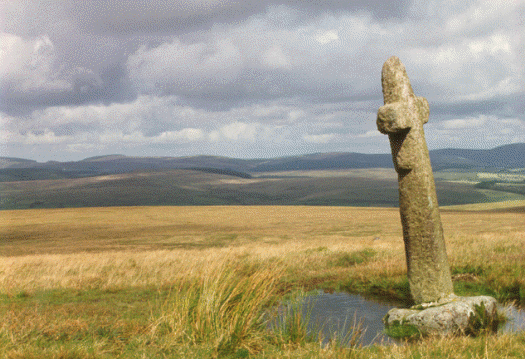
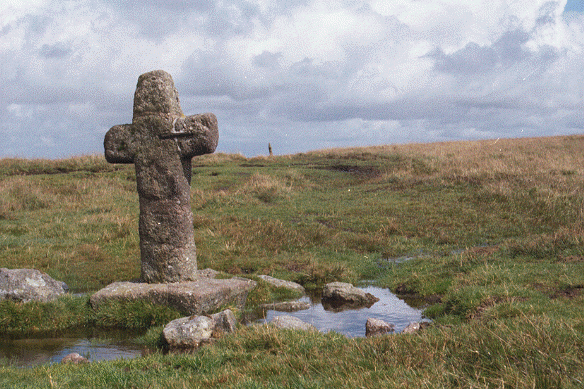
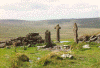
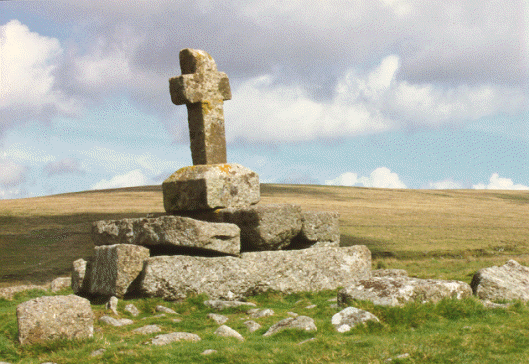
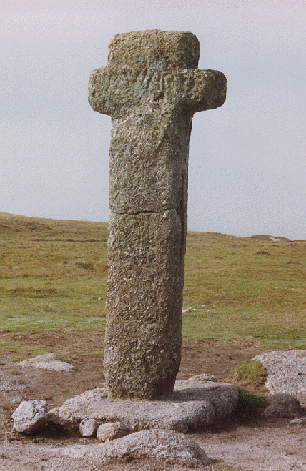

Alastair Fay is undertaking a project on Dartmoor crosses and he e-mailed to say that a local supervisor for a Duke of Edinburgh Expedition told him that the American army used some crosses as target practice in the second world war.. that is why they had a 115mm hole in them (tank shells) and needed to be restored.